
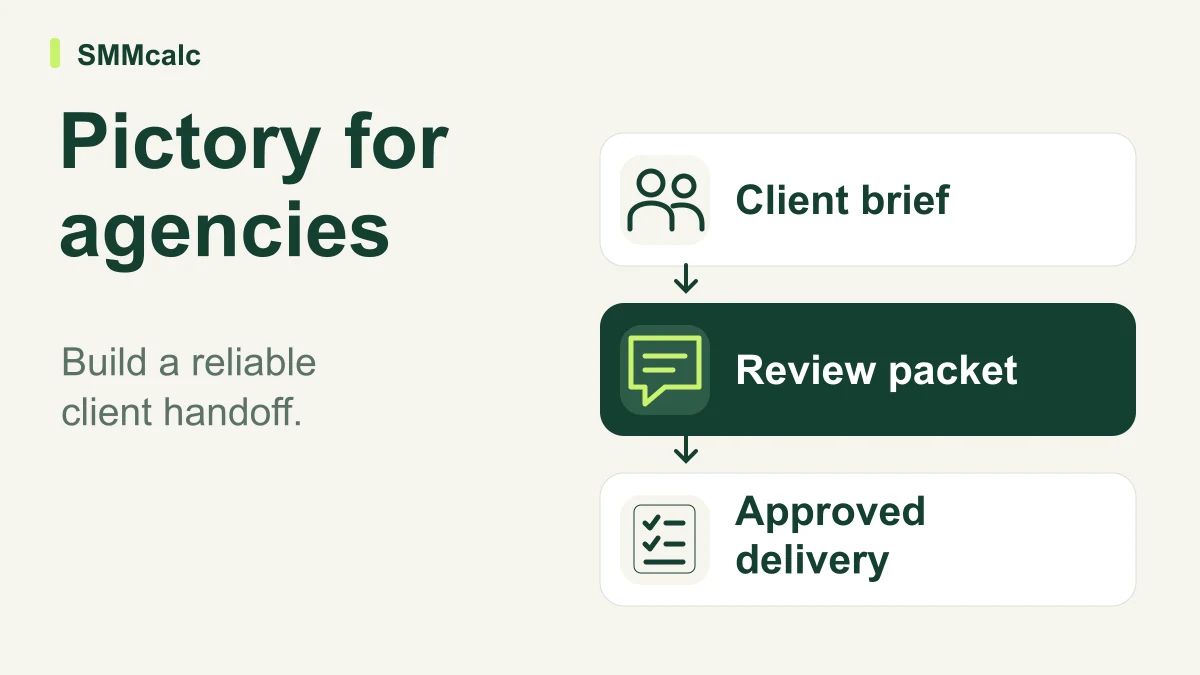
Pictory is worth an agency pilot when approved articles or scripts need to become repeatable video deliverables. The buying decision should turn on how reliably your team can hand off, revise and approve those assets across clients.
The verdict: evaluate it as an aid to a defined production process, with editors still responsible for meaning and quality. Faster draft assembly does not automatically improve agency margin if the saved time reappears as client corrections or last-minute finishing.
Choose one recurring deliverable to evaluate
An agency rarely has one universal video workflow. A short educational summary, a product demonstration and an original brand film place different demands on the people and software involved.
Begin with a recurring deliverable whose acceptance criteria you can write down. A concise summary of a client article is a useful candidate because the source material already exists and the team can check whether the video preserves its argument.
Pictory describes script- and article-led workflows that create editable scenes with visuals, captions and voiceover. That makes it relevant to this pilot without establishing that it can replace every task performed in your current editor.
A two-client pilot reveals more than a polished demo
Choose two clients with different tone and visual expectations. Give each a separate approved source, brand reference and output brief so reviewers can detect whether generic defaults are flattening their identities.
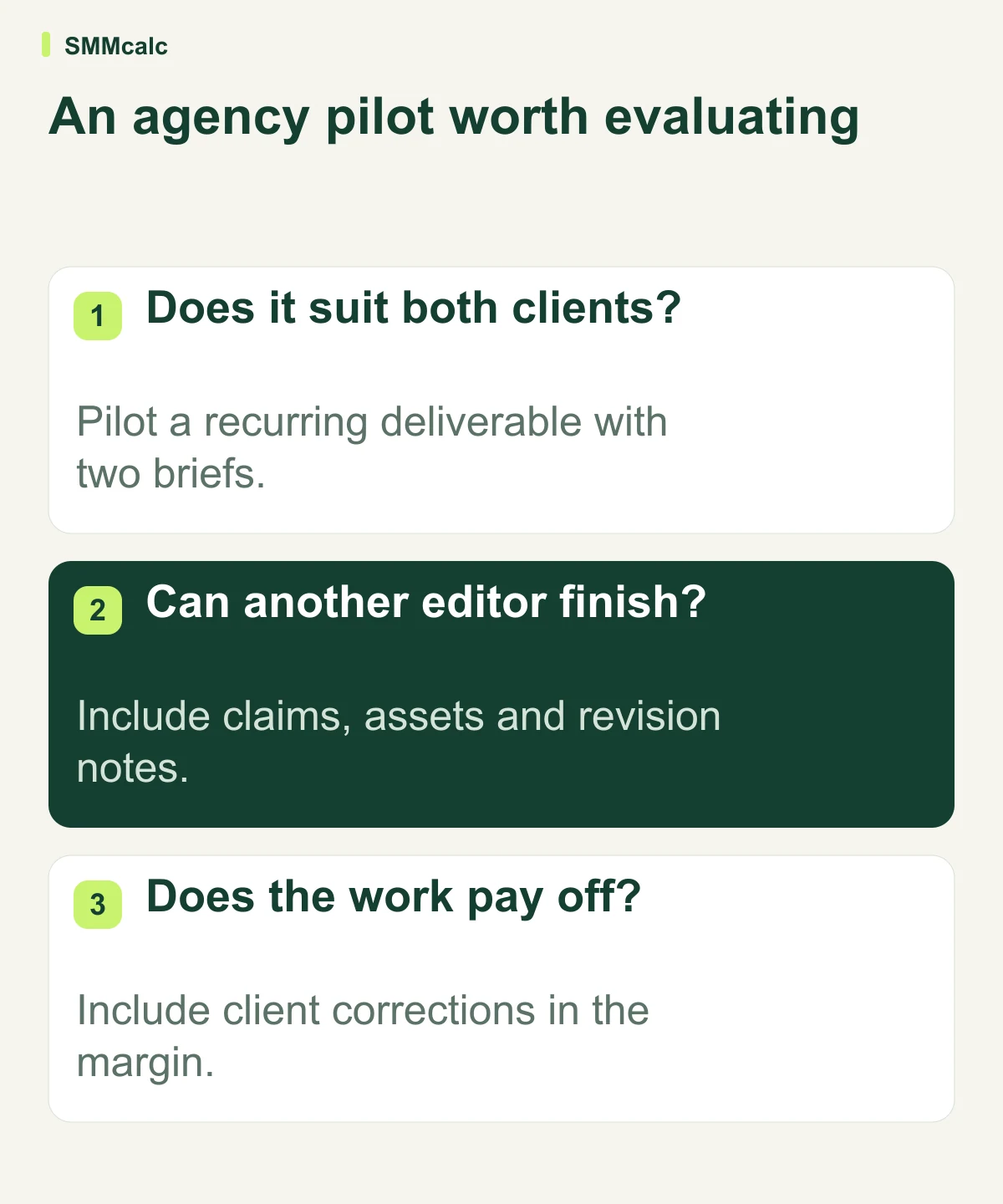
Ask the same person to produce an initial draft for each client, then have another team member make a substantive revision. The handoff exposes undocumented decisions that the original creator might otherwise carry in their head.
For example, change a product detail in one video and replace an overbroad claim in the other. Record how long the corrections take and whether the team needs to inspect the entire export again.
You can explore Pictory with that specific pilot, checking current plan conditions before subscribing. Do not infer project allowances, collaboration rights or included assets from an old trial description.
Build the handoff packet before scaling
A useful handoff packet identifies the source, approved script, intended audience and the visual decisions the next person should preserve. Include a short list of product names, claims and scenes that require particular care.
- Name the person who owns factual approval.
- Link each video to the exact source version used.
- Record the intended platform and aspect ratio.
- Mark any client-supplied footage or assets with usage conditions.
- State what is still open for creative revision.
- Identify the person who approves the final exported file.
This process reduces ambiguity whichever tool wins the pilot. It also prevents an attractive draft from bypassing normal review simply because generating it felt easy.
Use alternatives to separate genuinely different jobs
| Candidate | Agency assignment to investigate | Approval risk to check |
|---|---|---|
| Pictory | Adapting an approved article or script into scenes | Visuals may fit individual words while weakening the original explanation. |
| InVideo | Directing a new video from a campaign brief | The generated concept may introduce details that the client never approved. |
| JoggAI | A presenter-led product explanation or ad draft | The format may imply personal experience the presenter does not have. |
A conventional editor remains a reasonable choice for existing footage, detailed motion work or an assignment with precise visual continuity. The goal is to assign each job to a suitable process rather than force every client through one interface.
Measure margin after revisions
Track labor from receiving the source to delivering the approved file. Separate script correction, visual replacement, caption checking, client revisions and export problems so you can see where the new workflow helps or adds work.
Hypothetical example: a recurring deliverable is sold for $150, costs $10 in allocated software usage and takes two hours of labor valued at $40 per hour. That leaves $60 before other agency costs; reducing initial drafting by 20 minutes matters only if later revisions do not consume it.
The example describes a calculation, not an expected margin or a product price. Apply your own rates, overhead and actual deliverable requirements, including time spent on drafts that never reach the client.
Also review who can access each client's material and how confidential work should be handled. Keep sensitive information out of an unassessed workflow until the agency has checked the service terms and its own client commitments.
Create an exceptions queue
Some assignments will need a specialist even if the pilot succeeds. Product demonstrations, nuanced interviews, unusual terminology and demanding brand work should have a clear route to the person equipped to finish them.
Mark these exceptions during briefing rather than after a deadline is already close. A production process is stronger when it knows which work to escalate than when it promises that automation can handle everything.
Keep the original source and final approved file accessible to the team. A workflow that is quick today but difficult to revisit later can become costly when a client changes a detail or requests another format.
Choose on repeatability
Continue with Pictory if both pilot clients receive accurate, distinct work and another editor can make revisions without guessing. Improve the brief or retain the existing process if drafts look acceptable but approval remains unpredictable.
The strongest outcome is a reliable service your agency can explain and repeat. More drafts are useful only when they become deliverables clients understand and approve.
Capability checks used Pictory’s script-to-video guide, its blog-to-video workflow, InVideo’s product description and JoggAI’s URL-to-video guide.
