
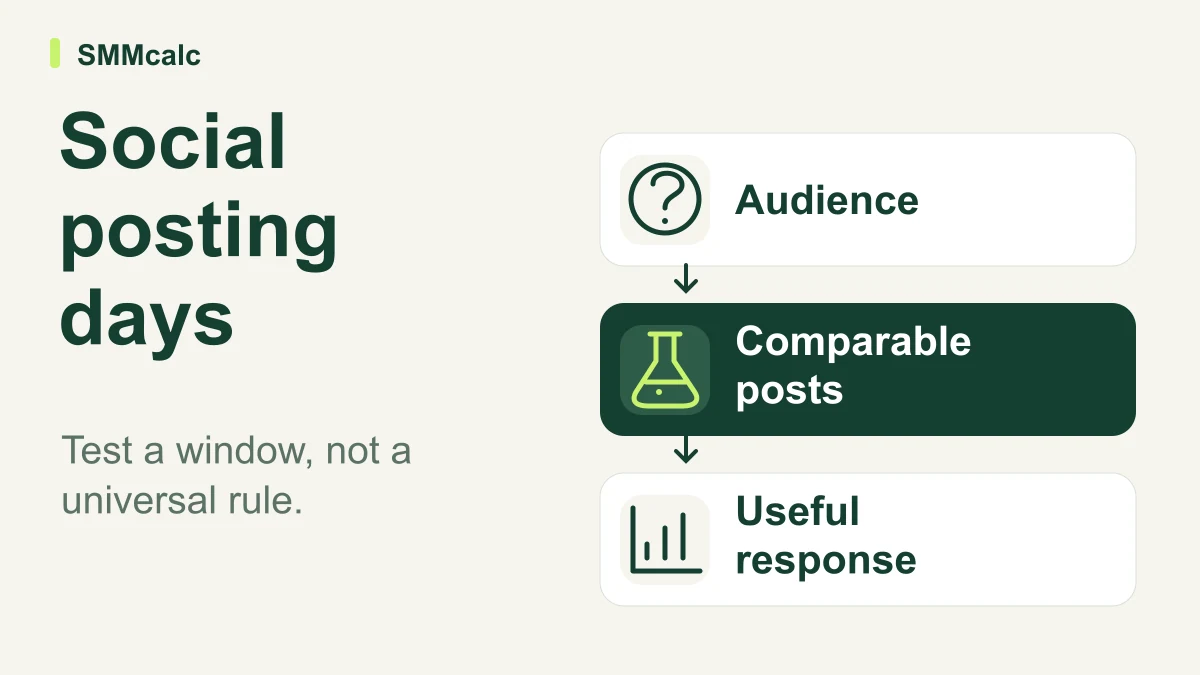
A useful posting day is an audience-specific hypothesis, not a universal answer. Hold the content format and objective reasonably consistent, compare recurring publishing windows, and decide whether scheduling software helps you execute the test rather than promising to fix weak content.
Replace the universal best day with a useful question
Ask when a particular kind of post has a reasonable opportunity to reach the audience you want. A weekday average from another business does not establish the answer for your account, content or time zone. Treat a suggested publishing window as a hypothesis to investigate.
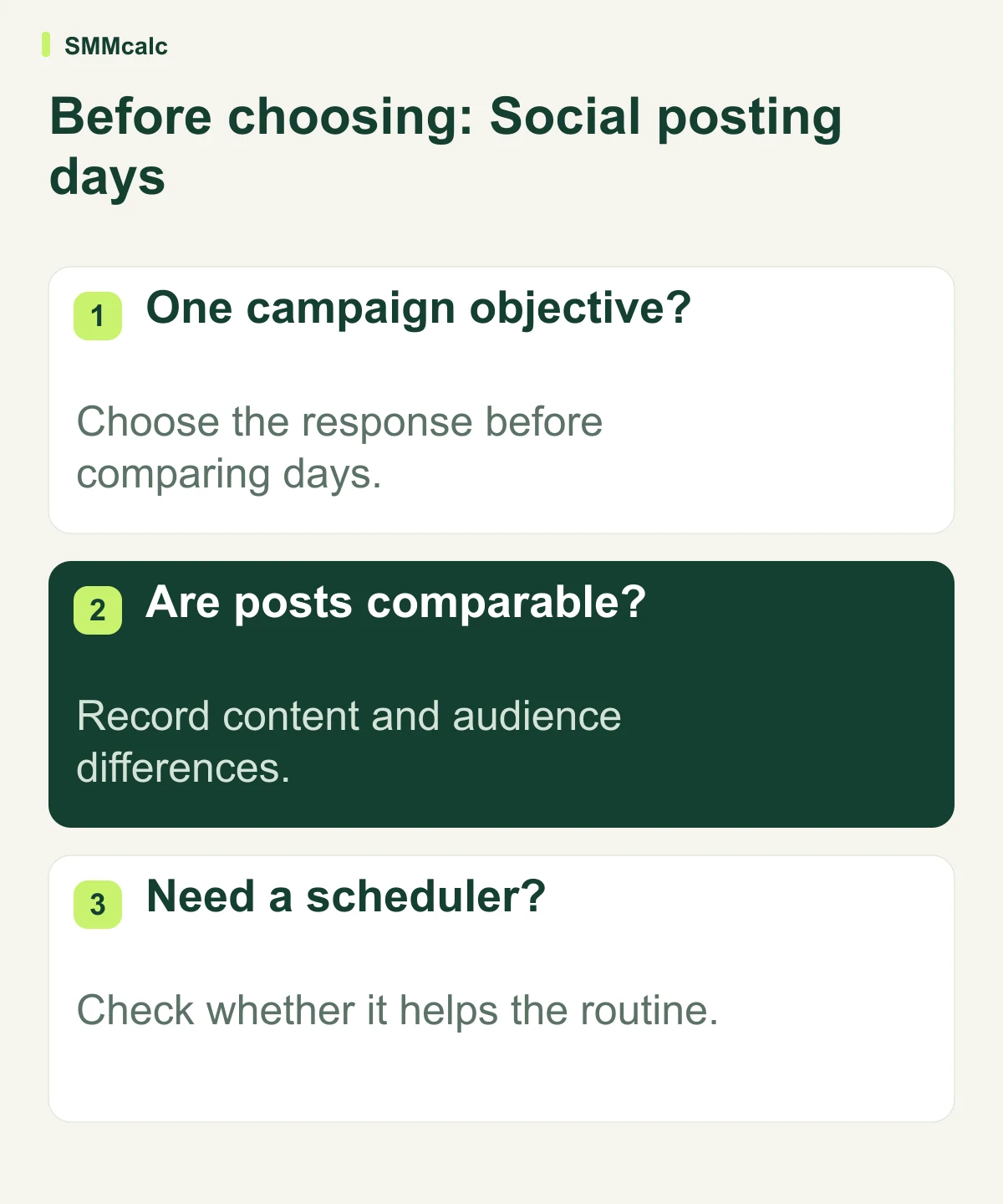
Choose the purpose of the post before selecting a measure. A useful discussion, a qualified visit and a casual reaction describe different responses. Avoid switching the objective after seeing which number looks strongest; that makes an ordinary fluctuation harder to interpret honestly.
Keep the comparison understandable
Compare recurring windows using posts with similar audience intent and format. Record an unusual topic, promotion or external event alongside the result. These notes do not remove every source of variation, but they help you avoid crediting the calendar for a response driven mainly by the content.
- Choose one audience and one recurring content format.
- Compare a small set of publishing windows instead of changing everything at once.
- Repeat the routine and record context before drawing a conclusion.
A hypothetical publishing experiment
Hypothetically, a consultant publishes similar educational posts in two recurring weekday windows. She records the objective and content format, compares results across several repetitions, and checks whether an unusual topic explains an apparent difference. A scheduler is useful only if it makes that controlled routine easier to maintain.
What a scheduler would need to improve
Evaluate the software as an execution aid: can you prepare the intended posts, confirm account and time-zone settings, and inspect the reporting you need? Test the actual required features in your account. Do not assume that a feature called optimal timing eliminates uncertainty or that a paid queue fixes an unclear message.
Native publishing can be a sensible starting point while you establish a routine. A scheduler becomes more relevant when preparing and maintaining that routine causes repeat work. Its value should be visible in the process you can sustain, without an unsupported promise of higher reach.
Choose the next experiment, then the tool
Start with a modest, documented schedule experiment using the analytics you already have. Consider Buffer only after verifying the specific timing or scheduling function you need; a general best-day claim is insufficient.
Inspect the current product details before choosing: Buffer, Metricool, Flick.
