Fabric.so is worth evaluating when your problem is finding useful material across a growing collection of notes, files and saved reading. The buying question is whether you can recover the right source when a task requires it. Capturing more information is valuable only if retrieval remains dependable enough to support your work.
Fabric’s official search documentation describes meaning-based queries, searches inside documents and navigation to relevant passages. That is an appealing foundation for a research workspace. It remains a documented capability, not proof that every query in your own library will return the right answer.
Use the capture-and-search assessment below, then the final buying decision, to evaluate a bounded set of your material. Avoid moving an entire archive before checking the workflow that matters most.
The problem it should solve before anything else
A useful knowledge workspace shortens the path from remembering an idea to inspecting the material behind it. You might remember a concept but not a filename, or know a meeting discussed a decision without remembering when. The source and its context matter more than a fluent summary.
Fabric’s positioning brings different content types into a searchable workspace. That makes it a plausible candidate for people whose information is fragmented across reading, files and notes. It does not make every existing application unnecessary; distinguish finding information from writing, project execution and long-term records management.
Start with the task you repeatedly struggle to complete. A researcher locating a quotation has different requirements from a designer recovering visual references. Your acceptance test should reflect that difference rather than copying a generic productivity workflow.
Capture is useful when retrieval survives it
Fabric documents capture routes for web material, files, notes and recordings, with searchable content. The possible benefit is reducing the interruption involved in deciding where every item belongs. You can evaluate that convenience without assuming you will never need organization or source review again.
A low-friction inbox also creates a practical risk: collecting material faster than you can assess it. Search can make a larger library easier to navigate, but it cannot decide whether a saved argument is credible or relevant to your current work. Keep the distinction between saving a source and accepting its claims.
For important work, require a path back to the original passage or recording. A useful answer should leave you able to verify what was actually said and whether nearby context changes the meaning. Treat summaries as aids to inspection rather than replacements for evidence.
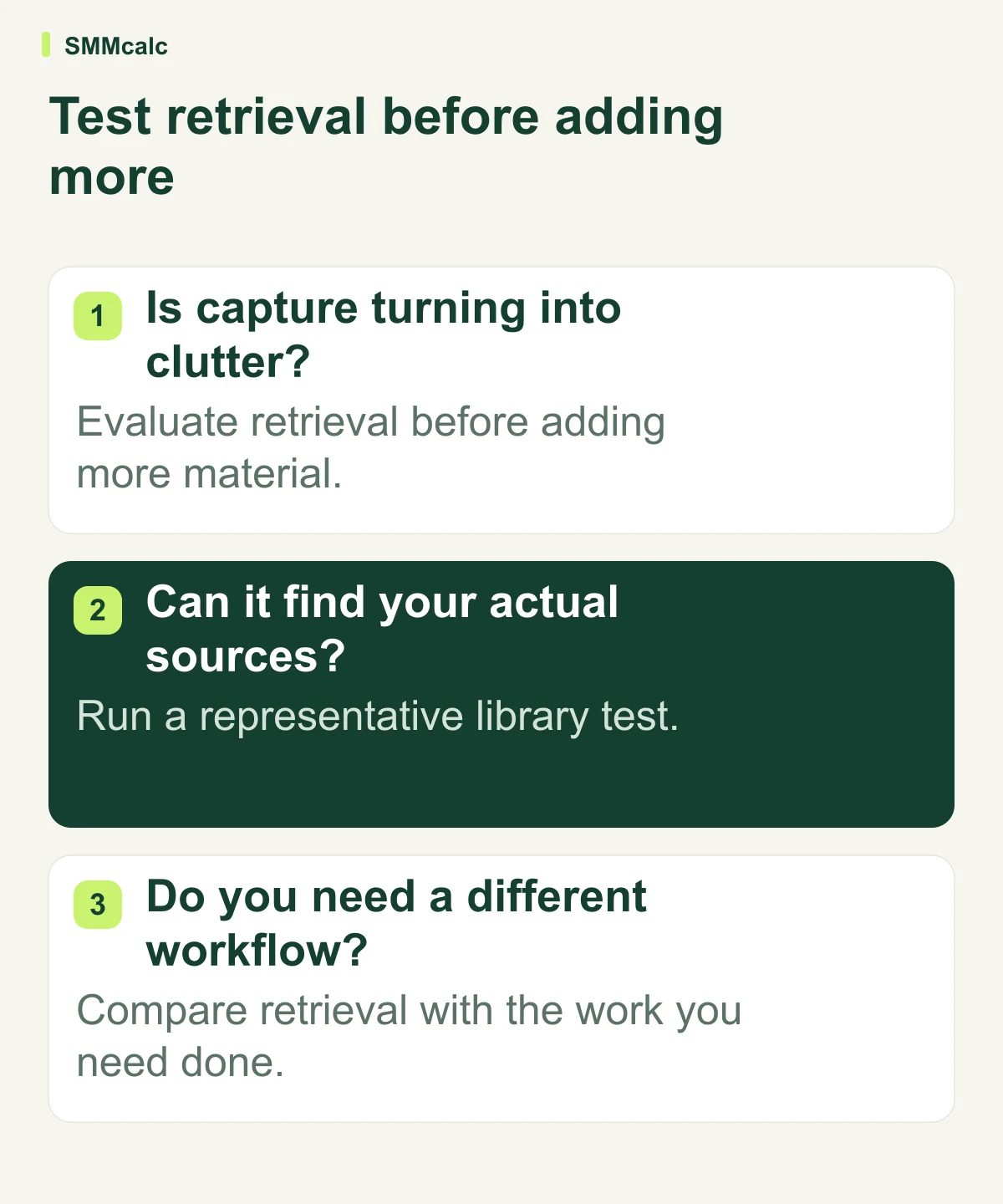
A hypothetical retrieval test for your own library
Create a small collection you are authorized to upload: a few saved articles, one PDF, your own notes and a short recording you have permission to process. Choose material you already understand so you can recognize missing context or an incorrect match. Keep the original files available outside the test.
| Retrieval task | What to inspect | Useful acceptance standard |
|---|---|---|
| Find an exact quotation | Whether the correct source and passage are accessible. | You can check the words and nearby context. |
| Find an idea without the original wording | Whether relevant results are distinguishable from merely similar ones. | You can explain why the selected source answers the question. |
| Recover a decision from a recording | Whether the source moment supports the interpretation. | The conclusion survives listening to the original context. |
| Use the result in a real task | Whether retrieval reduces searching without adding excessive checking. | The work is easier to complete at your normal accuracy standard. |
Repeat the same tasks with your present system. Record where Fabric helps, where it requires extra cleanup and where the source remains hard to verify. This is a hypothetical test design, not a claim about measured accuracy, speed or reliability.
The limitations to examine before importing more
First, check whether the content you need is actually accessible through the route you plan to use. A broad integration promise is not confirmation of a particular account, permission or file condition. Try the specific material before treating a connection as a solved problem.
Second, examine the boundary between search and generated answers. A relevant result can still be an unsuitable source, and a coherent synthesis can omit a qualification. When decisions matter, open the underlying material and verify the important claim yourself.
Third, review privacy, access and exit requirements before uploading sensitive information. Confirm what your organization permits, who can access the workspace and how you would retain important records if you later leave. Start with non-sensitive authorized material while evaluating those requirements.
Compare the kind of work, not the number of features
If your existing notes application already retrieves the material you need, changing systems may offer little benefit. If the main problem is assigning tasks or maintaining a schedule, evaluate a task-management workflow directly. Searchable capture and execution are related activities, but they are not the same buying requirement.
Fabric is more compelling when content genuinely spans formats and finding the original source repeatedly interrupts useful work. It is less compelling if the real bottleneck is deciding what to read, finishing an argument or maintaining a small collection you can already navigate comfortably.
Buy retrieval value, not another growing inbox
The positive case is specific: you save material from several places, need to recover it by idea or passage, and can verify the returned source. A successful trial should demonstrate that your real work becomes easier to complete. A large imported library alone is not evidence of that benefit.
Check the current storage, AI, connection and billing allowances before paying. The public pricing page did not provide a usable detailed plan table during this review, so exact prices and older free-tier limits are deliberately excluded. Do not make a purchasing decision from a stale storage figure or an assumed refund policy.
Check Fabric’s current starting options, then run the retrieval exercise before expanding the library. Consult the official search explanation and capture documentation for supported workflows; choose it if the verified result is more useful than the inbox you already have.