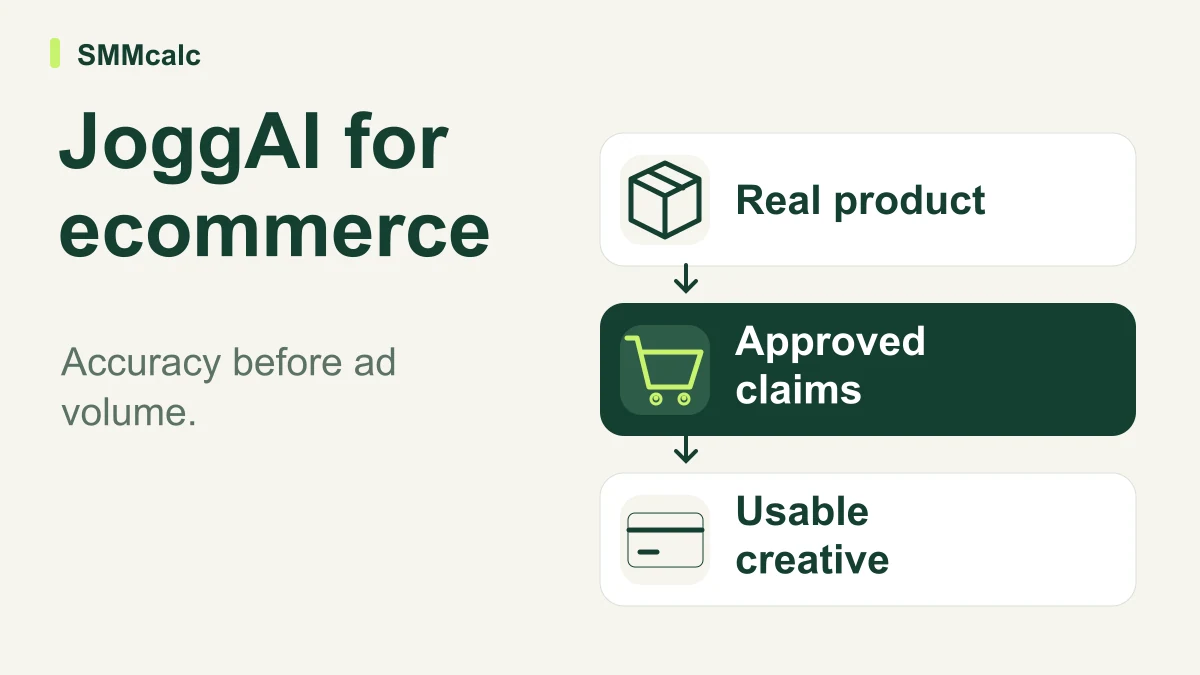
JoggAI is worth evaluating when you have a real product, approved marketing claims and a need to turn them into multiple video-ad drafts. Its product-URL workflow can reduce initial assembly work, but every variation still has to represent what customers will receive.
The central buying question is product accuracy: does the finished ad show and explain the actual item without inventing benefits, demonstrations or customer experience? More creative variations help only after that requirement is met.
For a fast route through the review, jump to the buying verdict. The practical evaluation below focuses on product truth, script control and the cost of a usable ad rather than unverified promises about conversions.
The verdict: useful for drafts, with a product-truth gate
Shortlist JoggAI for an avatar-led explanation, a product introduction or a campaign that needs several clearly differentiated hooks. Its official documentation describes taking a product URL, generating an editable script and selecting a presenter and voice.
Choose another production route when the argument depends on a real demonstration, a customer's genuine experience or detailed physical behavior. A generated presenter can deliver an explanation; it cannot supply evidence that someone used the product.
To test the fit, explore JoggAI’s current product-video options with one representative item. Check the current plan and allowances before assuming a particular trial will support a whole campaign.
Inspect what the product URL actually contributes
Product pages can contain old offers, variant information, shipping statements and promotional language. Review the imported material before turning it into a script, and remove anything that does not apply to the advertised item.
Create a short fact sheet with the approved product name, dimensions or specifications that matter, supported benefits and the offer you intend to run. Give the reviewer a direct way to compare the video with that sheet.
Pay particular attention to visual implications. A scene suggesting waterproof use, a specific size or an included accessory can create an inaccurate impression even when the voiceover avoids making that claim.
A better first project than twenty random variations
Start with one approved explanation of the product and build three hooks around different audience questions. Keep the underlying product facts, offer and final action constant so the team can see what changed.
| Hook angle | What it should communicate | What to avoid |
|---|---|---|
| Problem | A specific situation the product is designed to address | Invented customer frustration or a guaranteed result |
| Demonstration | A function supported by actual product evidence | Generated behavior that the product cannot reproduce |
| Buying objection | A clear answer drawn from approved product information | Unsupported superiority, fake scarcity or an outdated offer |
This is a proposed experiment, not evidence that one angle will perform best. The point is to create understandable alternatives that deserve a fair test, rather than treating every generated variation as a fresh marketing insight.
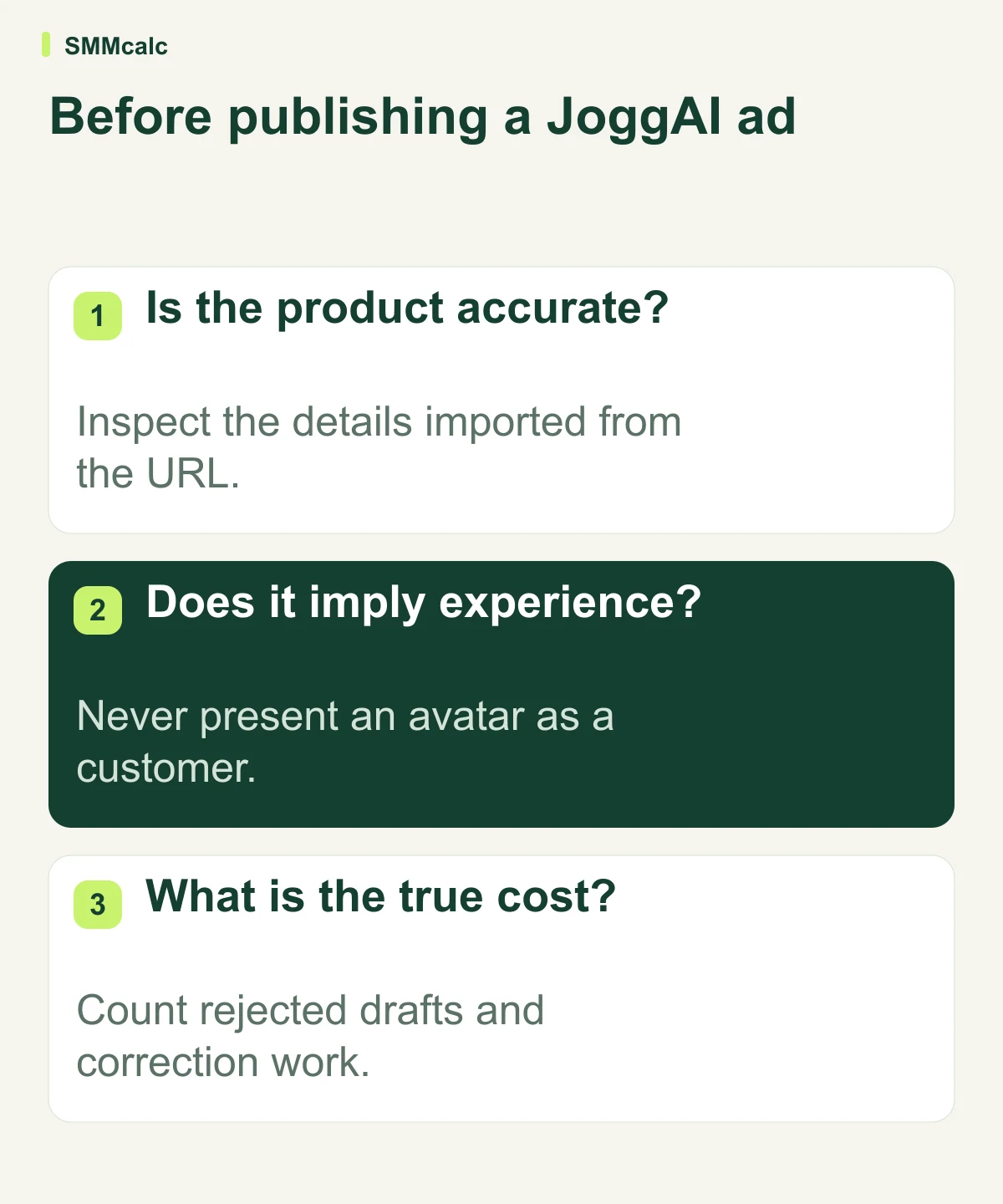
Where JoggAI fits in the workflow
JoggAI is the candidate here because its documented workflow connects product information with an editable script and an avatar-led format. That makes it relevant to teams evaluating repeatable product-ad assembly.
The tradeoff is that assembling an ad and substantiating an ad are separate jobs. Keep a human owner for product accuracy, script approval and the final export, even if generation itself takes little effort.
Review the script before concentrating on presenter realism. A convincing delivery of a weak proposition is still a weak ad, and a personable avatar does not make an unsupported claim more credible.
Do not confuse a presenter with a testimonial
Write generated-presenter scripts as explanations or clearly identified demonstrations of information. Avoid first-person statements suggesting an actual purchase, personal transformation or customer result unless that account is genuine and appropriately authorized.
If the selling point depends on someone holding, using or comparing the product in a real setting, record that evidence. You can still use software to assemble and adapt the material without replacing the reason the audience should believe it.
Make the format understandable to viewers and review the rules of the destination advertising platform. Synthetic presentation is a creative choice; it is not a shortcut around accuracy or the context the audience needs.
Calculate the cost of usable creative
Hypothetical example: generating twelve drafts consumes $48 of an internal production budget and two hours of review, valued at $30 per hour. If four ads pass approval, the production cost is $27 per usable ad: ($48 + $60) ÷ 4.
Those numbers are an illustration, not JoggAI pricing or a performance claim. Substitute your actual charges, labor assumptions and approved-output count, then compare with another production method for the same assignment.
Keep media spend and campaign outcomes separate from production costs. A cheap ad can still be ineffective, while a more expensive demonstration may explain the product more convincingly.
When to continue, and when to choose another route
Continue if the product remains accurate, the scripts are easy to improve and the output fits your intended audience. Test one variable at a time after approval so production speed does not obscure what you are learning.
Choose a simple editor for minor updates to existing footage, a real creator for genuine personal experience, or a specialist production team for a demonstration that demands physical detail.
If your need is repeatable, avatar-led product explanation, check JoggAI against one approved product brief. Start with evidence and a controlled test; scale the variations only when the workflow earns that decision.
The URL-to-video workflow is described in JoggAI’s official guide.