InVideo AI is worth considering for TikTok ads when your bottleneck is assembling variants of a clear idea. It is a weaker purchase when the missing ingredient is convincing evidence that your product works. An AI-generated scene can communicate an angle, but it cannot establish an authentic customer result or substitute for a truthful demonstration.
The useful question is how many ads your team can approve after review. Ten impressive drafts that all show the wrong product detail are less useful than three accurate variations you can actually publish. Treat generation speed as one input in that decision.
Start with one message you can prove
Write down the audience, the problem, the evidence and the offer before opening a video tool. For a physical product, decide which actual footage must remain in every version. For a service, decide which statements can be supported by your existing materials and which need to be removed.
This brief gives the software a specific job: arrange the story around evidence you already possess. Without it, generating more videos can multiply weak claims and disconnected visuals. A polished voiceover does not make a vague offer easier to understand.
InVideo currently describes an editing agent working on an editable multitrack timeline, including uploaded footage. That matters because you can plan a hybrid workflow rather than assuming every shot must be generated. The precise experience still needs a project-level check; the vendor description is not a performance test.
A hypothetical three-hook test
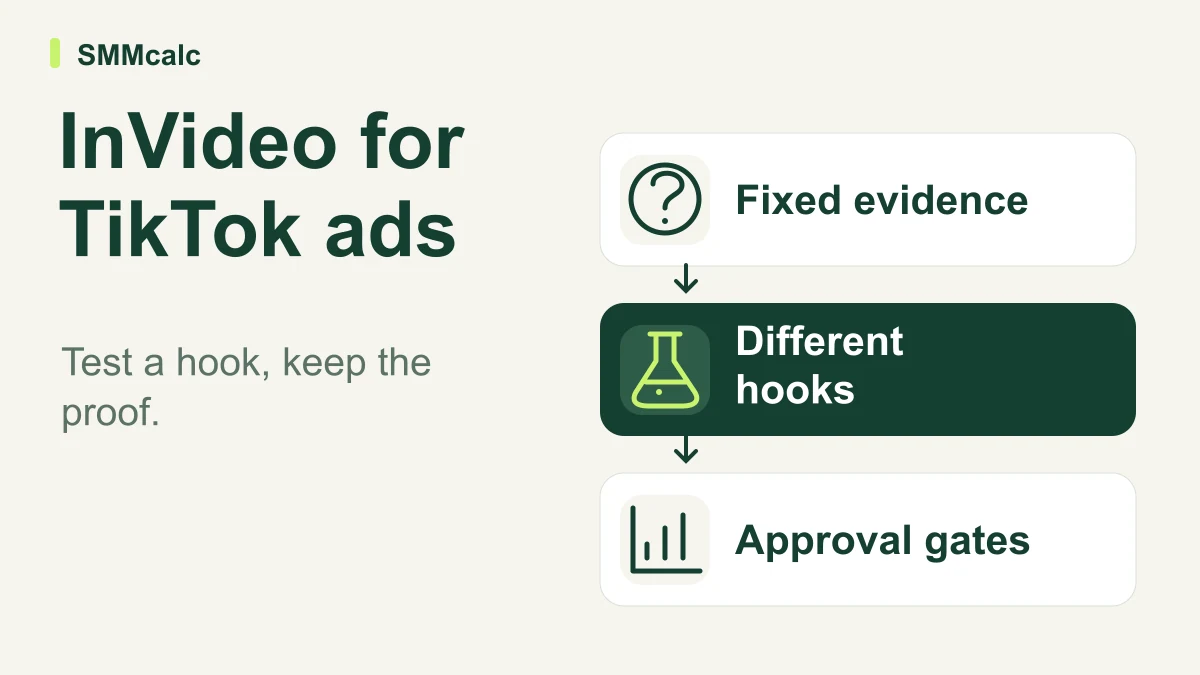
Imagine a small business selling a desk organizer. Its approved footage shows the same real desk before and after arranging cables, notebooks and pens. The test below changes the opening argument while leaving the demonstration and offer intact.
| Opening angle | What changes | What stays fixed |
|---|---|---|
| Problem recognition | Open on the clutter that makes the desk hard to use. | Real product footage, offer and closing action. |
| Immediate demonstration | Open on the organizer being used. | The same product claims and demonstration sequence. |
| Practical use case | Open on preparing the desk for a work session. | The same audience, duration target and destination. |
These are hypothetical creative directions, not predicted winners. The point is to preserve a question you can interpret: does a different introduction make this same offer clearer? If every version also changes the product, audience and promise, any response becomes much harder to explain.
Keep a simple version record with the opening angle, approved script and final asset name. That lets the person running the campaign identify what each version is meant to test. It also prevents an older draft with an unapproved claim from being mistaken for the final creative during handoff.
Give the agent a bounded assignment
Describe the material it should use, what it must preserve and what it may change. A useful instruction identifies the approved product footage, the intended opening angle, the order of the proof and the exact closing message. It also names prohibited additions, such as invented testimonials or visual claims the product cannot support.
Ask for one opening treatment first. Review it before requesting the remaining variations, especially when the product has precise dimensions, movements or visible labels. This reduces the chance of repeating the same misunderstanding across an entire batch.
The practical strength of conversational editing is that you can describe a revision in editorial terms. Nevertheless, inspect what changed after each request. A direction to make the opening more energetic should not silently rewrite your offer or remove an important qualification.
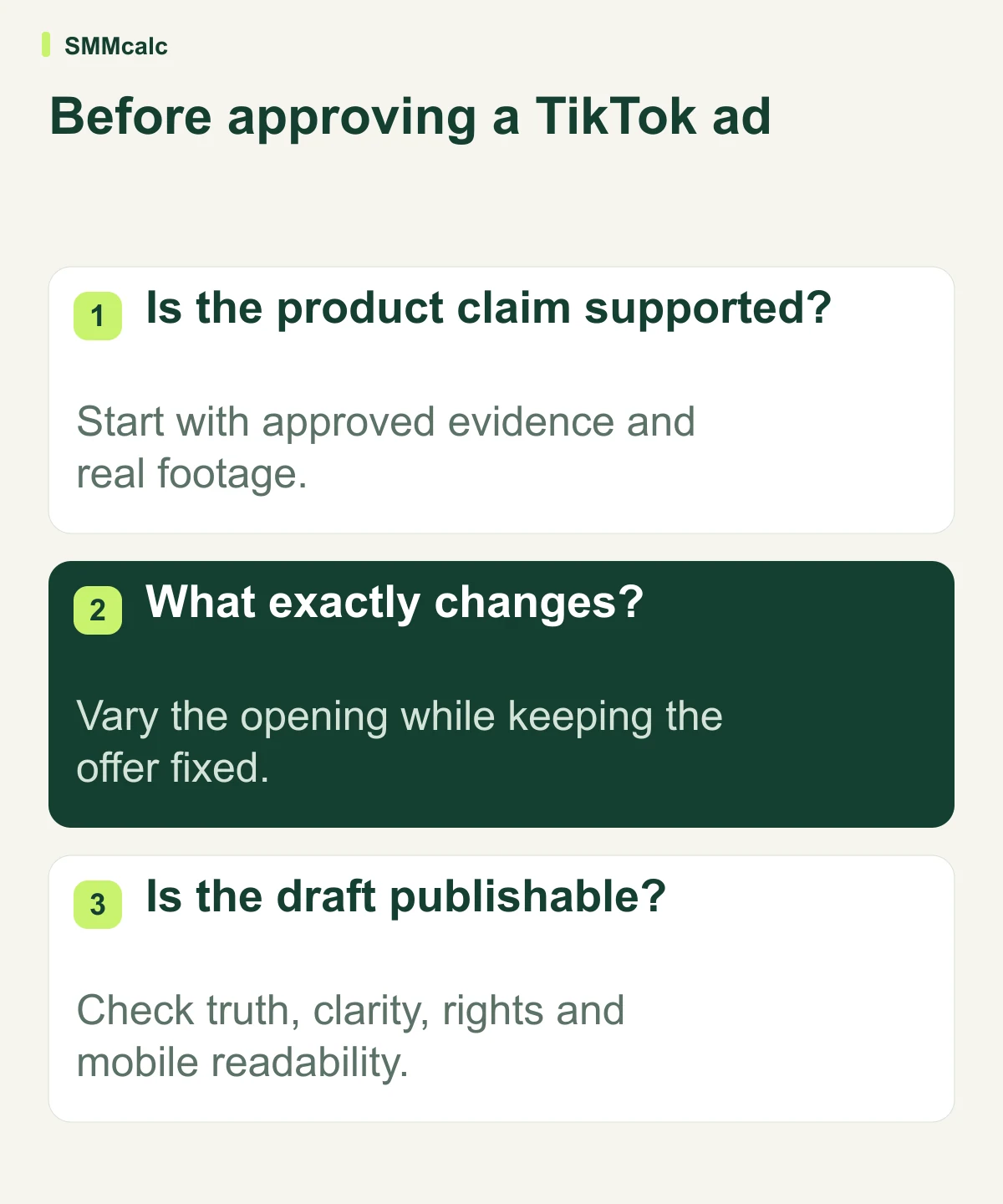
Use approval gates before calling a draft an ad
- Truth: Every visible product action and spoken claim agrees with approved evidence.
- Comprehension: A viewer can identify the problem, product and next step without relying on the caption outside the video.
- Mobile readability: Important captions and product details remain legible at the intended viewing size.
- Continuity: The same product and message remain consistent across scenes.
- Rights: You have permission for supplied footage, voices, music and any people depicted.
These gates are a review checklist, not a claim that software can guarantee compliance. Check the advertising platform’s current requirements separately before publication. Do not interpret a generated asset, stock license or available export button as blanket permission for every intended use.
When another workflow makes more sense
If you already have strong footage and only need to assemble a clean cut, compare the effort with your existing editor. Adding generation may create another review step without solving the bottleneck. If you lack believable product proof, spend effort on capturing it before buying a larger generation allowance.
InVideo is a more plausible fit for a marketer who can write a precise brief and review the resulting work. It is less attractive for someone expecting the tool to discover an offer, substantiate claims and deliver a campaign strategy from a product name alone.
The next decision: cost per approved variant
Record how long briefing, generation, correction and final review take for the three-hook exercise. Count only variants you would confidently approve; rejected drafts belong in the cost calculation too. Compare that total effort with producing the same set through your current workflow.
Keep paid distribution separate from this production decision. A cheaper or faster editing process does not establish that an ad will attract qualified buyers. Once the creative is accurate and publishable, you can decide whether an appropriately designed campaign test is justified.
For more background, the full review at FilipKonecny.com covers the original use case. Confirm current capabilities through InVideo’s official product page before choosing a plan.