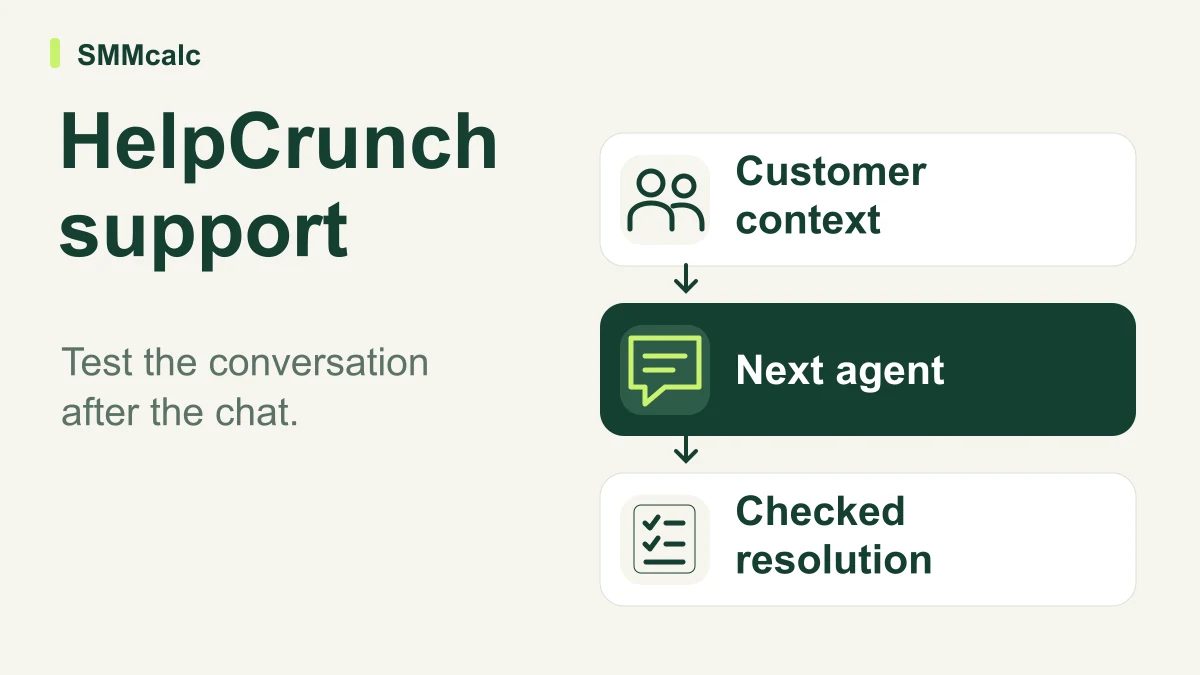
HelpCrunch should be judged by what happens to a support conversation after the first message. Can the next agent see the context, take ownership and resolve the issue across the channels you use? That practical handoff is a stronger basis for switching than a broad promise that a unified inbox will save every lost lead.
Follow a conversation across the handoff
Start with a support issue that requires more than a quick reply. Identify what the customer said, which details another agent needs and who should respond next. The evaluation should show whether the team can continue the conversation without asking the customer to repeat the same information.
HelpCrunch is a candidate for coordinating that work. Its official email-ticketing guide checked on October 28, 2026 describes chat and email as channels within the same conversation thread. Demonstrate the continuity your team requires rather than assuming a shared inbox proves every handoff works.
Give the test a realistic complication
Use permitted test information and send an email follow-up to an earlier chat. Include an attachment or another detail the next agent must inspect. Have a second agent take over and check where ownership, internal context and the next response are visible.
Test what happens when a reply arrives after a conversation appeared resolved. Ask whether staff can find the relevant history and avoid conflicting responses. Evaluate the actual workflow and current controls without assuming a feature name guarantees error-free coordination.
Separate a simpler chat need from complex service management
A team needing only a website conversation entry point may have a smaller project. Chaport is an alternative to evaluate for that focused job, with its current capabilities and terms checked separately. Do not infer missing features or a universal cost advantage from an older comparison table.
At the other end, specialist service-management requirements may include additional approvals, records or integrations. List those requirements explicitly and require a demonstration. A general customer-support inbox should not be assumed to meet every internal IT or organizational workflow.
Validate history and the full cost before switching
Check a migration sample before relying on imported conversations. Inspect customer identity, timestamps, attachments and which older records must remain accessible. Document what the migration can and cannot preserve, and plan a limited transition before moving the entire support workload.
Compare current charges for the required agents, channels, automations and add-ons. Include setup and the operational work that remains. A unified inbox can organize a process, but it does not guarantee faster replies, retained customers or an immediate financial return.
Good fit: Small support teams coordinating website chat and email who want clearer conversation ownership and can test the current workflow before migration.
Main tradeoff: A shared inbox does not establish migration completeness, suitability for complex internal ticketing or the support quality your team will deliver.
A situation to work through
Hypothetical example: a customer starts in live chat and later replies by email with an attachment. Two agents test whether they can find the context, identify who owns the next reply and avoid sending conflicting answers. Before a switch, the team checks a sample of imported history and documents what must remain accessible in the old system.
Three checks before choosing
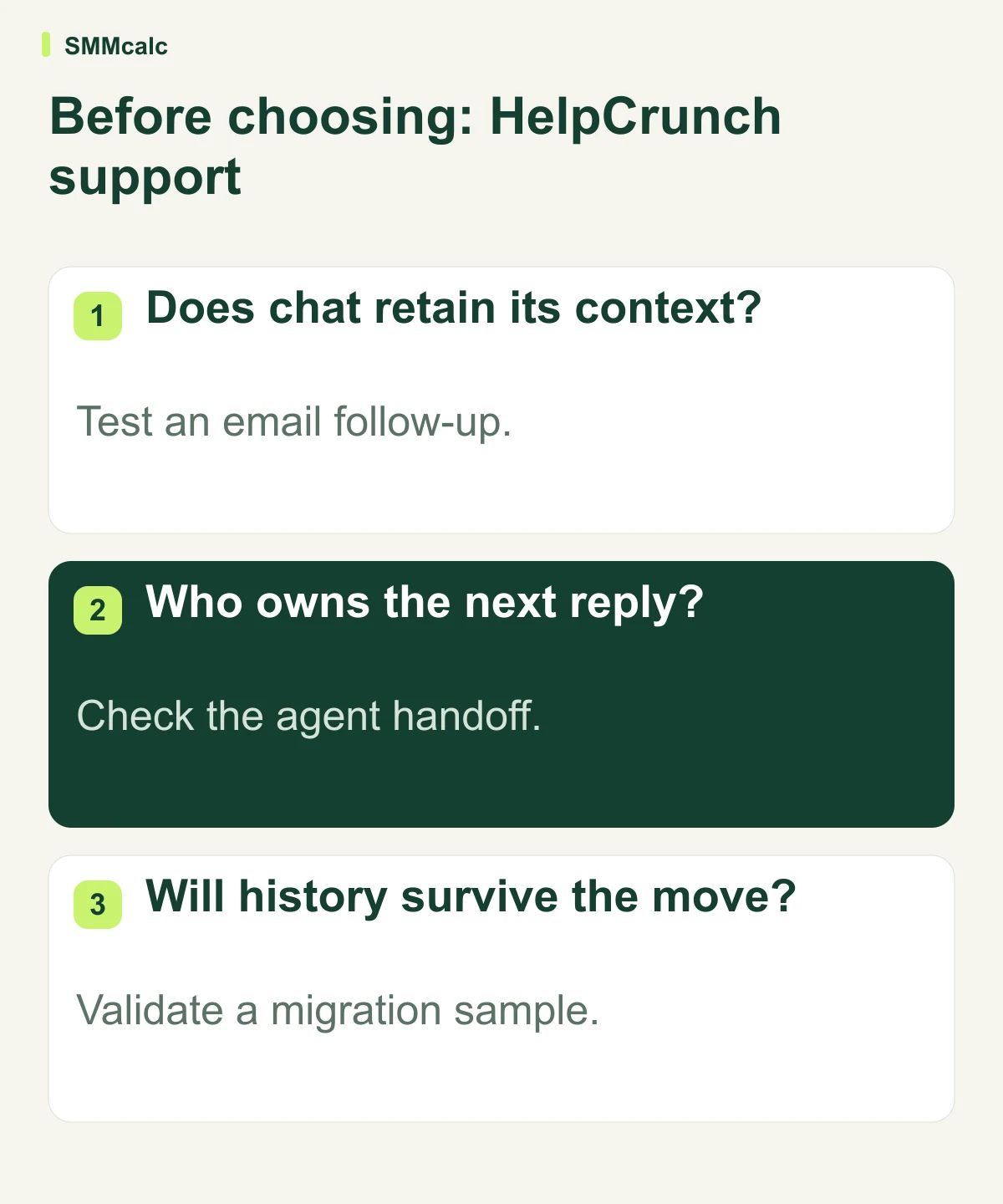
- Does chat retain its context? Test an email follow-up.
- Who owns the next reply? Check the agent handoff.
- Will history survive the move? Validate a migration sample.
Your next step
Evaluate HelpCrunch with a representative conversation and the agents who will handle it. Check channel requirements, ownership, migration history and current billing. Switch only when the completed workflow improves a real support problem without losing information your team needs.