
InVideo AI deserves a project-level evaluation if you want help turning ideas and footage into edited video. Its appeal is the possibility of delegating production work while keeping the ability to revise the result. The buying decision depends on how well that handoff works for your material, not on the most impressive example in a demo gallery.
This is an editorial assessment of the documented workflow, not a claim of hands-on testing. The recommendation is conditional: consider it when you can define a finished-video standard and inspect the work against it. Wait when your content plan or approval criteria are still unclear.
What you are actually evaluating
An assisted editing workflow has several jobs: understand the brief, select appropriate material, arrange a coherent sequence and leave you with a result you can correct. A weakness in any one can erase the convenience of the others. Accurate control over the final edit matters more than a long list of generation options.
InVideo’s current official material describes an editing agent and an editable multitrack timeline. Earlier descriptions of the product as necessarily lacking timeline control no longer make a reliable buying shortcut. Assess the available editor in your account and the tasks you intend to perform.
The strongest potential benefit is reducing the mechanical work between a good script or collection of footage and an inspectable first cut. The continuing responsibility is editorial: deciding what is true, what is essential and whether the visual story communicates it accurately.
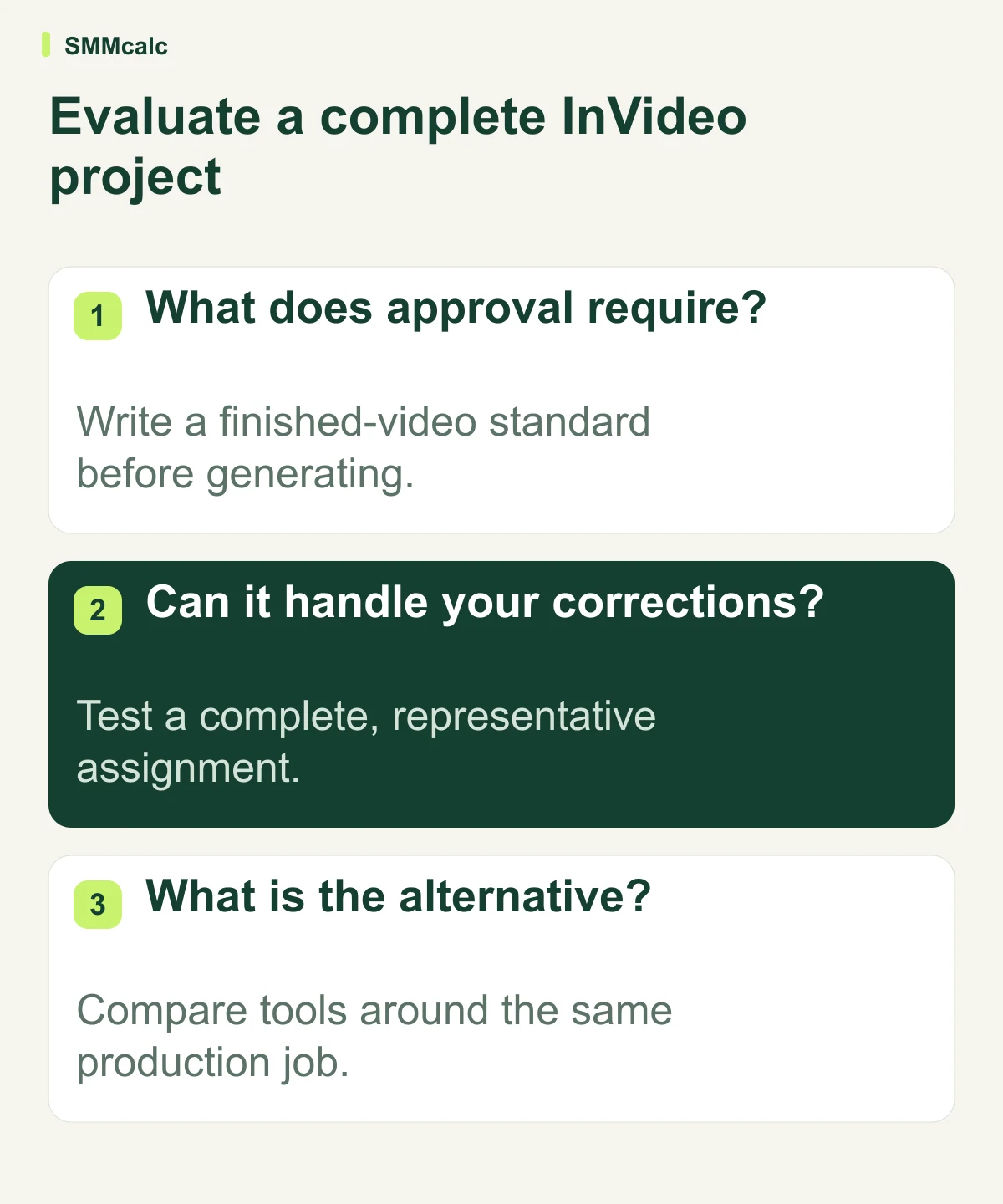
Give the trial a finished-video standard
Choose one project that resembles your normal work. A polished product demo is a poor substitute if your actual workload is interview editing; a short stock montage reveals little about a detailed tutorial. Use material that exposes the decisions your publishing process really requires.
- Meaning: Write the main conclusion and any qualification the cut must preserve.
- Evidence: Identify the shots or sources that cannot be replaced with illustrative material.
- Presentation: Set the intended audience, format and acceptable narration style.
- Revision: Name one expected correction so you can assess how local edits behave.
- Delivery: Confirm the export and asset conditions your publication needs.
Evaluate these requirements before you get attached to an attractive draft. Otherwise, visual polish can distract from a missing qualification or an edit that changes the story. Keep the approved source material available throughout the review.
A hypothetical acceptance test
Suppose a consultant has an approved script explaining a client onboarding process and several recordings of the real workflow. The assignment is to build a clear introduction, keep the actual demonstration in order and avoid implying that illustrative scenes are client footage. The source material is deliberately ordinary because it resembles the consultant’s recurring work.
The first review asks whether each essential step is still present. The second asks whether the narration and visuals agree. The final review introduces a small revision, such as extending one explanatory moment, to see whether the surrounding sequence remains intact.
The test passes only if the consultant can approve the result without rebuilding the project. That threshold is hypothetical and personal; another buyer may reasonably accept more correction or require greater control. Neither outcome establishes a universal rating for the product.
Save the original draft and the approved edit so that you can see what your intervention added. If the improvement required rewriting the argument or replacing most visuals, the tool solved a smaller part of production than the first impression suggested. Include that distinction in the buying decision.
Strengths to look for, and limitations to expect
Look for a clear relationship between your instruction and the change it produces. That makes conversational editing useful: a request should lead to an inspectable result you can accept, refine or undo. If revisions routinely alter unrelated material, include the recovery work in your evaluation.
A broad creative tool also introduces choices about models, generated assets and how much work to delegate. More options can be useful, but they can also make a simple job harder to budget. Establish a narrow default workflow before experimenting with every available mode.
Generated realism should receive particular scrutiny. A plausible image of a product action, workplace or event can communicate something that never happened. Where authenticity is part of the argument, retain real evidence rather than approving an attractive substitute.
Free access is an evaluation route, not a production guarantee
InVideo’s help center currently documents free access with limited credits. Use it to investigate the interface and the scope of a representative task, then confirm the terms shown in your account. Do not assume an old plan name, watermark statement or generation-minute allowance still describes the current product.
Keep manual editing separate from AI spending in your notes. The vendor distinguishes manual timeline work from chargeable agent and generation activity. This helps explain why two projects of the same finished length can require different allowances.
Compare by the job you need completed
Pictory is a relevant comparison when a prepared script or web page is the main input. Assess whether its route makes that specific conversion easier. Do not assume it is automatically cheaper or less capable without checking the required plan and final output.
Synthesys is another candidate if your planned format involves AI presenters or generated marketing videos. Compare the same brief and approval standard across options. A wider feature inventory matters only when those features help the actual job.
Inspect InVideo’s available starting options and use the official editing-and-credit guidance to understand the handoff. Subscribe when a representative project becomes easier to finish at your standard; keep evaluating when the benefit exists only in an idealized demo.
